
What a Waste!
Turning Garbage Into Gold

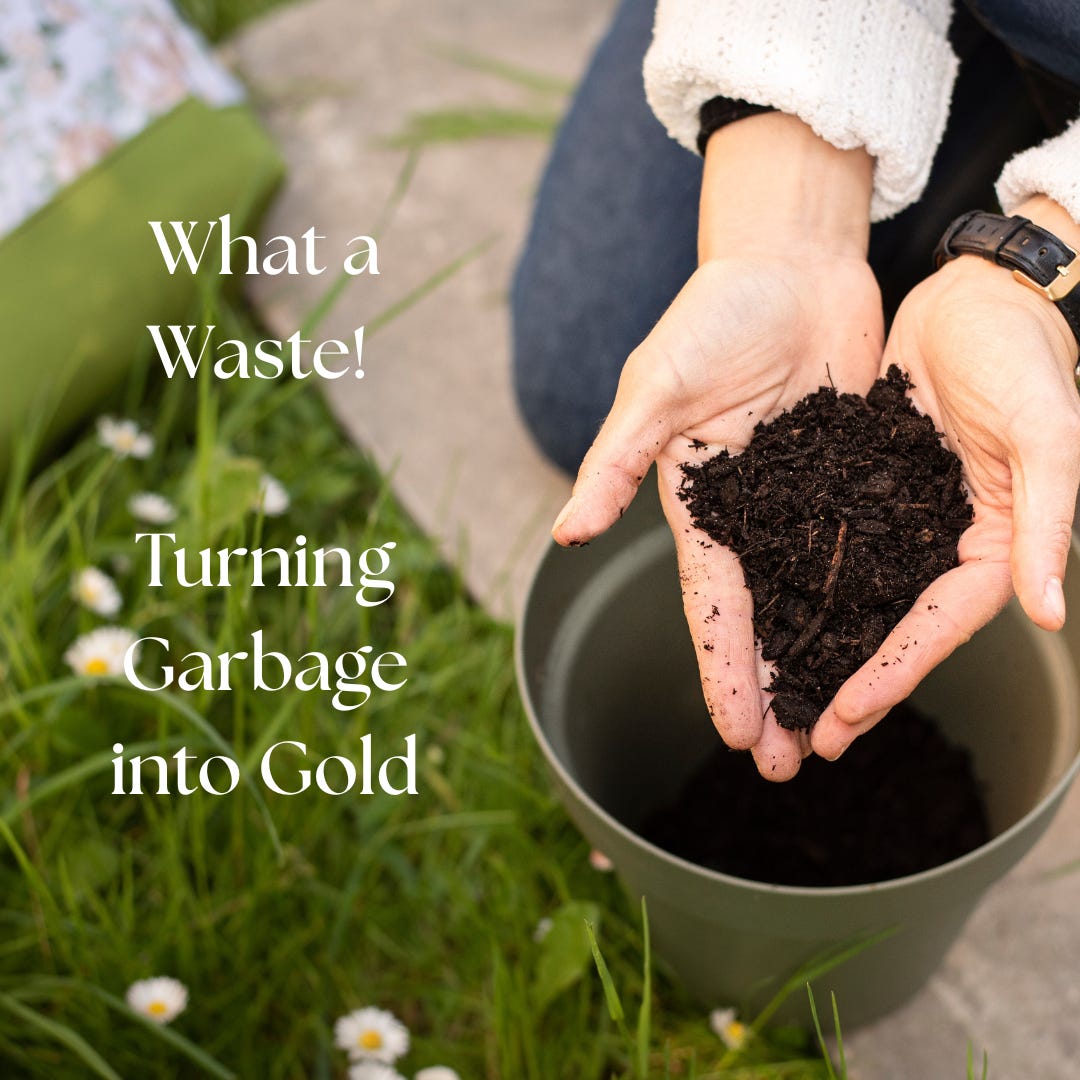
Nature is prolific in offering wisdom and metaphors that can be applied to human experiences; we are part of nature after all! I notice these sage encounters everywhere—from the bees waltzing symbiotically with blossomy partners to autumn’s beautiful leaves gracefully letting go. These evoke such lovely images. Today, however, I’d like to talk about the compost pile, attractive for its functionality versus its aesthetics.
My husband and I live in a rural area, and we have a compost pile in our yard. This is the place where we toss whatever biodegradable scraps remain from food preparation. We also have a larger compost area where we toss fallen branches, clippings from pruning plants, and other decaying flora. We set these rotting items aside where they won’t contaminate our daily lives, trip us up, or create some kind of health issue, while also supporting our responsible disposing of the trash in our lives. What I mean by responsible disposal is to seek ways that have a positive impact or, if that’s not possible, a neutral impact or least harmful impact. We put compostable garbage in our yard, not somebody else’s, in spots where we can turn the piles over if needed and otherwise let nature transform them over time into something useful.
As human beings in nonprofit leader positions, personal and professional growth is an expectation made of us consistently, both indirectly and directly through messages ranging from the micro to the macro. Sure, some of our experiences are fulfilling, but our jobs also require us to manage a lot of unpleasant crap, a good deal of which somebody else may have dropped on our doorstep. Our reactions become part of the mix.
Handling physical garbage shares some similarities with dealing with the intangible debris of messy social interactions. Our health as nonprofit leaders, in part, depends on our ability to handle this kind of energy trash in a timely and responsible manner. We need to ask ourselves some questions to assess the possibilities. Can I or someone else use this situational stuff I’m left with, as is or slightly altered, for any positive purpose now? With some time and effort, can I turn the remains of my unpleasant experience into something different that is useful at some point? How do I dispose of anything toxic that cannot be neutralized in a manner that is safe for myself and others?
The better we are at emptying our internal waste baskets and garbage bins, the healthier we will be in our relationships with ourselves and others. The more adept we are at understanding which things can be reused, repurposed, or recycled, the gentler our imprints will be. The more competent we are at finding the appropriate container for whatever is toxic and setting it aside until it has half-lifed its way to harmlessness, the greater our capacity for creating safe and secure environments.
We can choose to pick up the peels, pits, husks, and cobs before they become vile and attract vermin. We can set them in a place away from our main work area, but in a spot we visit regularly, where we turn the steaming heap over every once in a while so it can breathe in the air of change, and give time and space for the breaking down of things. With care, patience, and the digestive aid of our allies, the microbes, we can experience the gradual transformation of mucky scraps into nutrient-rich material. And we can use that composted superfood to grow things, including ourselves.
If you have a topic or are facing a challenge you’d like me to write about in an upcoming post, please comment or contact me.
Well, now I have to get back into composting - and therapy. :)